Encoder symmetries
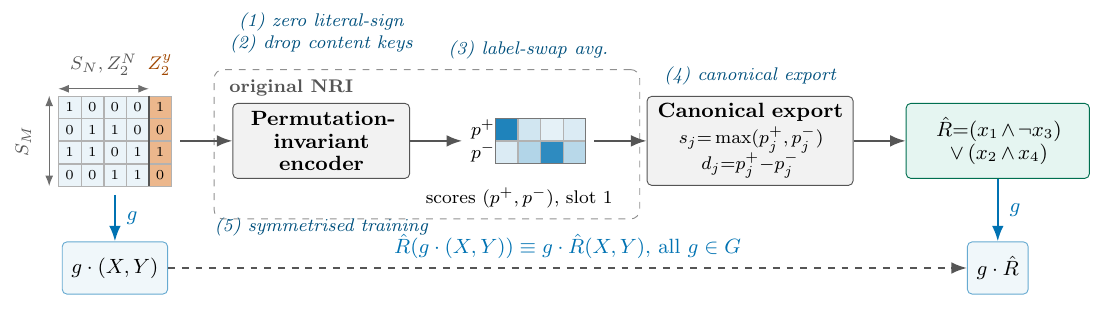
The encoder is modified to respect variable-renaming and polarity symmetries, without increasing the number of learned parameters.

G-NRI is a symmetry-aware extension of NRI for zero-shot logical rule induction. It is trained on synthetic Boolean formulas and produces explicit rules from examples in new datasets, without task-specific retraining.
Reordering examples or renaming variables should not change the underlying inference problem. G-NRI incorporates these symmetries, together with polarity flips and label swaps, into rule induction.
The method extends NRI through encoder changes, symmetrized training and evaluation, and canonical rule export. It retains the same model size and examples-to-rules interface.
The encoder is modified to respect variable-renaming and polarity symmetries, without increasing the number of learned parameters.
The export procedure preserves score symmetries when converting model outputs into a discrete logical rule.
Label-swap averaging and a symmetrized training objective account for both label encodings in binary classification.
We train on synthetic logic problems with 6–12 variables and evaluate the same frozen checkpoints on problems with up to 1,024 variables. The plots report accuracy on the conditioning examples and rule fidelity on held-out inputs.
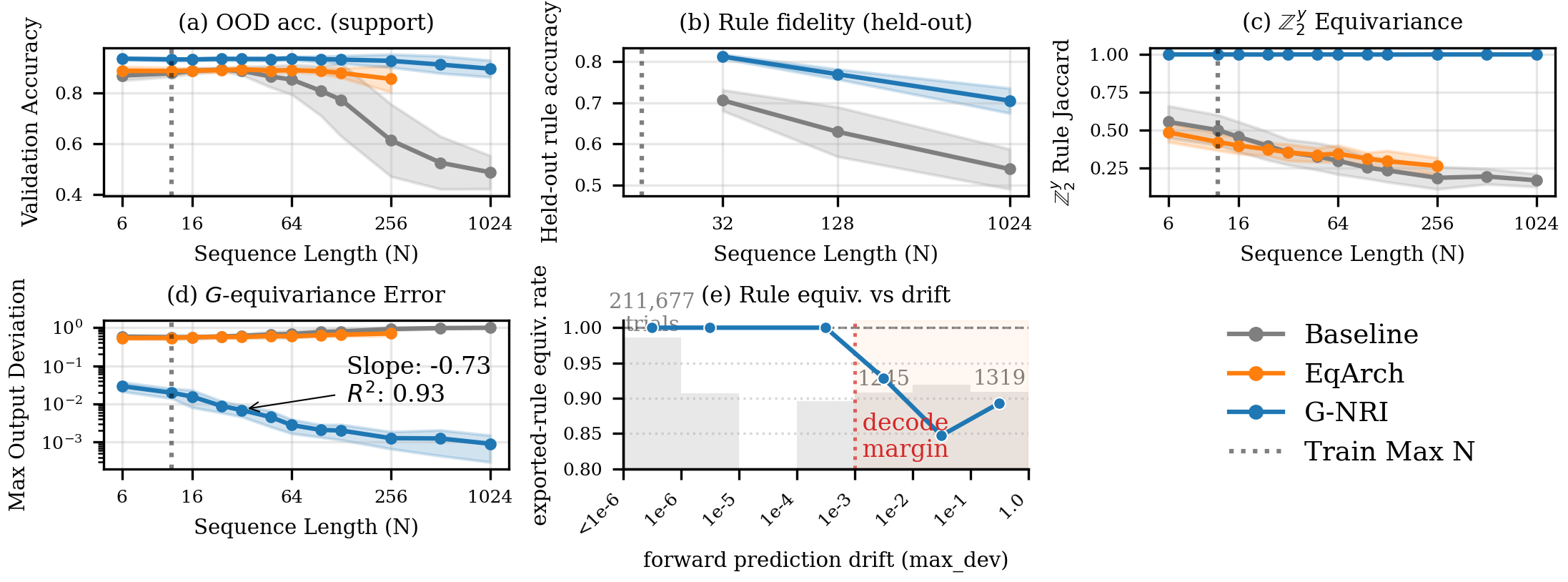
Panels (a) and (b) of Figure 2, across eight training seeds. The dotted line marks the training maximum of 12 variables. These experiments increase variable count within the same rule family. View the full figure.
Across 19 benchmark datasets, mean held-out accuracy is 76.2% for G-NRI and 70.2% for NRI, using frozen weights for both models. The datasets include tabular classification, MONK's logic tasks, molecular features, and symbolic scene descriptions.
Example rule
¬body_shape_octagon ∧ ¬jacket_blue
On MONK's-3, G-NRI returns this same two-literal rule across all eight seeds.
| Dataset | Variables | NRI | G-NRI | Decision tree |
|---|---|---|---|---|
| adult | 105 | 65.6 | 64.4 | 81.5 |
| breast-cancer | 9 | 92.7 | 92.0 | 93.7 |
| car | 21 | 30.4 | 73.8 | 96.7 |
| credit | 46 | 70.7 | 80.7 | 80.6 |
| diabetes | 8 | 72.0 | 71.8 | 70.0 |
| german | 61 | 58.4 | 60.9 | 65.3 |
| hepatitis | 32 | 80.6 | 80.0 | 77.7 |
| ionosphere | 34 | 71.9 | 73.1 | 79.4 |
| kr-vs-kp | 73 | 66.8 | 69.9 | 99.6 |
| mushroom | 116 | 78.0 | 81.0 | 100.0 |
| nursery | 27 | 68.4 | 75.9 | 98.7 |
| spambase | 57 | 71.0 | 79.0 | 90.7 |
| tic-tac-toe | 27 | 60.1 | 69.9 | 93.1 |
| vote | 32 | 91.3 | 94.3 | 94.5 |
| monks-1 | 17 | 74.1 | 74.6 | 98.4 |
| monks-2 | 17 | 61.1 | 55.9 | 98.5 |
| monks-3 | 17 | 90.3 | 96.4 | 96.8 |
| mutag | 51 | 63.9 | 73.1 | 84.6 |
| clevr-hans3 | 105 | 66.4 | 81.5 | 100.0 |
| Mean (19) | — | 70.2 | 76.2 | 89.5 |
The G-NRI repository includes synthetic training, rule export, benchmark evaluation, and scripts for the paper's tables and figures. Instructions are available for CPU training and experiment reproduction.
For the original model and its results, visit the NRI project page.
TBD — will be updated once the official NeSy 2026 proceedings are released and registered.